

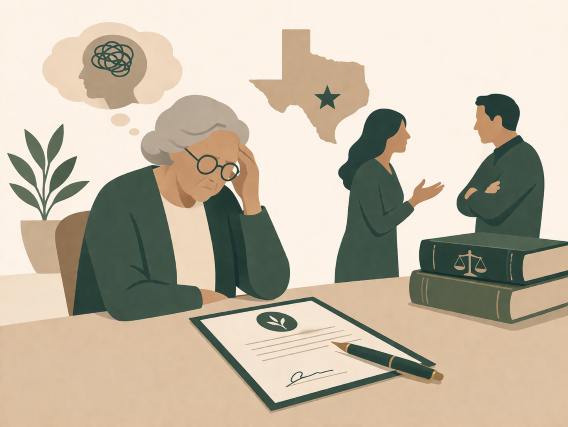

You put a lot of care and attention into your will, which signifies your financial legacy and your wishes regarding how it will pass to your loved ones at the time of your death.
Wills can, however, be contested under certain circumstances, and a common reason is lack of testamentary capacity—or lacking the capacity to make important decisions on one’s own behalf, which potentially includes dementia.
Understanding the impact that your own dementia – or alleged dementia – could potentially play in how your estate is ultimately resolved can afford you a better understanding of your estate planning needs.
When it comes to a matter as important as your estate plans, having the professional legal counsel of an experienced Temple estate planning attorney backing you up is always in your best interest. Never wait until it is too late to draft your will.
Your Legally Binding Will
For your will to be legally binding in Texas, a wide range of factors must apply. These include all the following:
You must have been at least 18 years old when you created the will, which means that you had legal capacity at the time. Being a member of the military or being legally married also suffices.
You must have been of sound mind when you created your will, which means that you understood you were creating a will and you understood its legal impact, which translates to having testamentary capacity.
You must have had testamentary intent, which means that you intended for the legal document to determine how your assets will be distributed upon your death.
Further, the document must be in writing, which means that it can be handwritten, typed, or printed. If you write your will out by hand, however, the entire document must be in your handwriting, and while it must also be signed by you, the witness requirement does not apply.
If your will is typed or printed, you will need two witnesses who must also sign the document. Choosing witnesses who are disinterested parties – or who have no financial stake in your estate – adds an additional layer of protection.
You also have the option of including a self-proving affidavit, which requires the signatures of two disinterested witnesses and notarization. A self-proving affidavit helps to streamline the process of verifying your will during probate by eliminating the need for witnesses to testify regarding its authenticity.
Contesting a Will
In order to contest a will, the party doing the contesting must base the matter on grounds that are recognized by the law. It is important to point out, however, that – in order to contest a will – the individual doing so must have standing, which means they must have a valid financial interest in the estate.
Lack of Testamentary Capacity
When an individual contesting a will cites the testator’s dementia as grounds, they call the testator’s testamentary capacity into question.
If the party contesting the will can demonstrate that the testator did not have the necessary mental capacity to appreciate the nature and effect of the legal document at the time of its execution, they may have valid grounds for contesting the will.
While dementia or mental illness can suffice, these impediments do not necessarily nullify the testator’s testamentary capacity out of hand.
Undue Influence
If someone else exercised undue influence over the testator in relation to their will to the degree that it does not reflect their authentic wishes, it is grounds for contesting the will’s validity.
Undue influence can translate to exercising some form of control over the testator, such as manipulation, coercion, or threat. Anyone who stood to inherit under the terms of a prior will or as a matter of the laws of inheritance in Texas may have standing to contest a will based on the grounds of undue influence.
Fraud
Wills can also be contested based on the testator being tricked into executing a will that is not a reflection of their personal wishes.
Examples include feeding the testator false information that may influence their decisions, tricking the testator into signing a will that is different than described or withholding information from the testator that could affect the terms they include in their will.
Defining Testamentary Capacity
The legal standard for testamentary capacity in Texas requires that all of the following elements apply to the testator in question:
They have the mental capacity necessary to understand the effect that their last will and testament will have at the time of their death.
They have the mental capacity necessary to appreciate the extent of the assets and properties that they own and their general nature.
They have the mental capacity necessary to know who their next of kin is and to know who their closest living relatives are.
They have sufficient memory to consider the elements of the business at hand, such as the creation of a will, and to hold these elements in their thoughts long enough to appreciate their obvious relation to one another and to form a reasonable judgment regarding them.
While dementia can absolutely affect a testator’s testamentary capacity, it does not necessarily render them incapacitated for the purposes of creating a legally binding will.
Ultimately, each case involving a contested will – based on any grounds – must be considered in relation to the relevant circumstances, which are always unique to the specific case at hand.
The Burden of Proof when a Will Is Contested
The burden of proof when it comes to a will that is contested on the grounds of lack of testamentary capacity, such as dementia, depends on when the matter is contested.
If it is contested prior to probate, the executor of the estate – as named by the testator in their will – is called upon to prove that the testator had the requisite capacity not only to understand what they were doing but also to appreciate the implications of their decisions in relation to the future.
Once a will has made its way through the probate process, however, the burden of proof shifts to the party who is contesting it.
In order to prove a testator’s lack of testamentary capacity, the contesting party must have evidence backing them up. Evidence like the following can help prove either lack of testamentary capacity or testamentary capacity – depending on the circumstances involved:
Medical records that speak to the mental capacity of the testator
Statements issued by the testator’s doctor as well as by other medical professionals who served them
Statements from the testator’s lawyer that address their client’s testamentary capacity
Suspicions regarding or valid reasons for unexpected provisions that were included in the will, such as if a close relative who was expected to inherit was left completely out of the legal document
Key Factors when It Comes to Proving Lack of Testamentary Capacity
There is a range of factors that tend to speak to a testator’s lack of testamentary capacity, and that should always be taken into careful consideration.
A Medical Diagnosis of Cognitive Impairment
If the testator has a diagnosis of a condition that could potentially affect the testamentary capacity of their medical record, it will play a key role in the proceedings.
For example, a diagnosis of a serious mental illness that is not well treated, a serious brain injury, or advanced Alzheimer’s Disease prior to the execution of the person’s will is likely to support contest.
Psychiatric Evaluations
If the testator has psychiatric assessments in their medical records that highlight a mental incapacity affecting their ability to comprehend the nature and consequences of their actions in relation to the creation of a will, they can play a pivotal role in a will contest.
For example, if the individual was experiencing severe depression or delusions related to dementia when their will was executed, demonstrating that their decision-making capacities were diminished may not be a stretch.
The Observations of Those Closest to the Testator
The testimony or observations of those who know the testator well can also have a profound impact on the case.
For example, if a close relative of the testator reports that the individual failed to recognize them on several occasions or was frequently disoriented during the timeframe when their will was executed, it can raise serious questions about their testamentary capacity.
The Testimony of Expert Witnesses
When a medical or mental health expert testifies to the impact of the testator’s mental state on their testamentary capacity, it can carry considerable weight in terms of their will being contested.
For example, if an expert in the field of Alzheimer’s speaks to the disease’s effects on decision-making for someone at the stage of the disease that your loved one was in at the time they executed their will, it can cast considerable doubt on their testamentary capacity.
Audio or Video Recordings
While audio and video recordings do not rise to the level of legally binding wills in Texas, they can serve as supplementary evidence of a will’s authenticity. When either such recording exists and when it highlights the testator’s inability to comprehend the situation or to communicate clearly, it can be used to strengthen a will contest case.
Inconsistencies
A primary concern when it comes to proving testamentary capacity is inconsistencies.
For example, if there are discrepancies regarding the provisions included in the will, if there are major differences between a previous will and its current iteration, or if the provisions included tend to suggest confusion or an inadequate understanding of their meaning, the matter of the person’s testamentary capacity will need to be considered.
When a testator consistently and clearly shares their intent to distribute their assets in a specific manner, but their will reflects something very different, the glaring inconsistency can be viewed as a red flag.
A serious shift in values – as reflected by a testator’s will – with no rationale supporting it is generally reason enough to investigate the testator’s testamentary capacity more carefully.
Finally, if a testator makes it very clear that X, Y, or Z will be going to a specific relative, but their will, which was created at around the same time, reflects something very different, it can be indicative of confusion.
Each of these factors can also be used in the opposite capacity. For example, the testator’s medical record may reflect keen awareness, and a video recording at the time of their will’s execution could speak directly to their testamentary capacity.
If your loved one’s legal capacity to execute a will is called into question, turn to a determined estate planning lawyer to help you build a strong defense in solid support of your relative’s rights and wishes.
Claiming Lack of Testamentary Capacity Is Not Proof of Incapacity
The fact that a loved one is slowing down, may not think as fast on their feet as they once did, or has changed their mind on a will-related issue, does not mean that they lack testamentary capacity.
A disgruntled relative who believes they deserve more of your loved one’s estate, however, could still attempt to contest the matter. The surest means of protecting your family member’s financial legacy and ensuring that their wishes are upheld is retaining the skilled legal representation of a formidable estate planning attorney early in the process.
Discuss Your Concerns with an Experienced Temple Estate Planning Lawyer Today
If your loved one’s will is being contested on the grounds of dementia or lack of legal capacity, it makes the grieving process that much more challenging, but it is important to know that you are not alone.
At the Law Office of Brett H. Pritchard, our clients benefit from a dedicated legal team that includes attorneys with extensive experience in Texas probate and estate planning. Brett Pritchard brings decades of legal leadership and trusted client service to every case, ensuring you receive attentive and knowledgeable support.
Learn more about what we can do to help by contacting us online or calling us at 254-781-4222 and scheduling a FREE consultation today!