

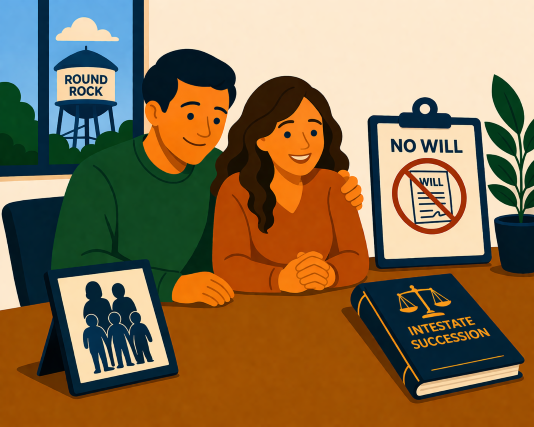

The death of a loved one is always difficult, but when that person passes away without a valid will, the situation becomes even more challenging. Without written instructions on how property should be distributed, Texas law decides who inherits the estate.
This process, known as intestate succession, follows strict statutory guidelines and often leads to unexpected results for surviving family members.
At The Law Office of Brett H. Pritchard, we have helped countless Round Rock families handle the legal and emotional challenges that arise when a loved one dies intestate. Understanding how intestate laws work and how they apply to your specific situation can help you take the necessary steps to protect your family’s financial future.
What Does It Mean to Die “Intestate”?
When someone dies intestate, it means they left no valid will at the time of death. A will serves as a legal roadmap for how a person’s property should be distributed after death, who should serve as executor, and sometimes who should care for minor children.
If there is no will, Texas courts must rely on the Texas Estates Code to determine:
Who inherits the deceased person’s property;
How much each heir receives; and
Who has the authority to administer the estate.
The absence of a will removes personal choice and can create confusion, conflict, and financial hardship for surviving relatives.
The Importance of Probate in Intestate Cases
Even without a will, the estate still goes through a process known as probate. Probate allows the court to:
Identify and collect the deceased person’s assets;
Pay outstanding debts, taxes, and expenses; and
Distribute the remaining property according to Texas law.
When no will exists, the court will appoint an administrator (instead of an executor) to handle these tasks. This person is usually a close relative, but if the family cannot agree, the judge may select a neutral third party.
The administrator has a fiduciary duty to manage the estate honestly, accurately, and in accordance with the law.
Step-by-Step Overview of the Intestate Process in Round Rock
When a Round Rock resident dies without a will, the process typically follows several key stages.
Filing for Administration
A family member, creditor, or interested party must petition the Williamson County Probate Court (or the county where the decedent lived) to open the estate. The petition requests the appointment of an administrator and outlines the known heirs.
Notice and Hearing
The court will schedule a hearing and issue notice to potential heirs and creditors. During this hearing, the judge confirms whether the deceased truly left no valid will and determines who should serve as administrator.
Identifying and Valuing Assets
The administrator must identify all assets, including bank accounts, real estate, vehicles, investments, and personal property. They are also responsible for determining the estate’s value at the time of death.
Paying Debts and Taxes
Before heirs receive any assets, all outstanding debts, medical bills, funeral expenses, and taxes must be paid from the estate's assets. Creditors must be properly notified and given time to submit claims.
Determining Heirs
If no will exists, the court must determine legal heirs through an official process known as an heirship proceeding. This may involve testimony from relatives and witnesses to confirm family relationships. Once confirmed, the court issues a Judgment Declaring Heirship, which formally identifies who inherits.
Distributing Property
Once debts and administrative costs are settled, the remaining property is distributed to the heirs as directed by Texas intestate succession laws.
How Texas Intestate Succession Works
Texas intestate succession divides property according to the deceased person’s family situation, whether they were married, had children, or had surviving parents or siblings.
Community Property vs. Separate Property
Texas is a community property state, meaning property acquired during marriage generally belongs to both spouses equally. However, property owned before marriage or acquired by gift or inheritance is considered separate property.
This distinction plays a central role in determining inheritance.
Married with Children (All Children Shared with Spouse)
If the deceased was married and all children were with the surviving spouse:
The surviving spouse keeps all community property;
The spouse inherits one-third of the separate personal property; and
The remaining two-thirds of separate personal property goes to the children in equal shares.
For separate real estate, the spouse receives a life estate in one-third of the land (meaning the right to use it for life), and the children inherit the remainder interest.
Married with Children from a Previous Relationship
If the deceased had children from another relationship:
The surviving spouse keeps only their one-half share of community property;
The deceased’s half of the community property goes entirely to the children;
The surviving spouse inherits one-third of separate personal property and a life estate in one-third of separate real property; and
The children inherit the remainder of the separate property.
Married Without Children
If the deceased was married but had no children:
The surviving spouse inherits all community property;
If the deceased’s parents are alive, the spouse gets one-half of separate real property and all personal property, while the parents share the other half of the real property;
If the parents are deceased but siblings survive, the siblings share that half instead.
Single or Widowed Individuals
If the deceased was unmarried at the time of death, their property passes to the following individuals in order of priority:
Children (and their descendants);
Parents (if no children);
Siblings (if no children or parents);
Nieces and nephews;
Extended relatives such as grandparents, aunts, uncles, and cousins.
If no living relatives can be found, the property ultimately escheats to the State of Texas, meaning the state becomes the legal owner of the property.
What About Stepchildren, Unmarried Partners, and Friends?
One of the most challenging aspects of intestate succession is that Texas law does not automatically provide for:
Stepchildren not legally adopted;
Unmarried partners; or
Close friends or caretakers.
Regardless of emotional closeness, these individuals generally inherit nothing under intestate laws. This often comes as a shock to families in long-term unmarried partnerships or blended households. Creating a valid will is the only way to ensure nontraditional heirs receive part of your estate.
The Role of the Heirship Proceeding
When a Round Rock resident dies without a will, determining heirs is not always straightforward. A heirship proceeding may be required, especially if there are multiple marriages, estranged relatives, or disputed parentage.
During this process:
The court appoints an attorney ad litem to represent unknown heirs;
Witnesses testify about the decedent’s family history; and
The judge issues a written Judgment Declaring Heirship, which becomes legally binding.
This judgment is critical for transferring title to real property, distributing financial assets, and closing the estate.
Managing Real Estate and Other Property
In intestate estates, transferring real property can be complicated, especially if multiple heirs are involved. For example, if three siblings inherit equal shares of a house, they must agree on whether to sell, rent, or keep it jointly. Disagreements may lead to a partition action, where the court orders the sale of the property and divides the proceeds.
Bank accounts, vehicles, and other titled property also require proper documentation. Some assets, such as life insurance or retirement accounts with named beneficiaries, transfer outside of probate and are unaffected by intestate succession laws.
Debts, Liabilities, and Final Expenses
Before any heir can receive an inheritance, all outstanding debts and financial obligations of the estate must be settled. These often include credit card balances, unpaid medical bills, funeral and burial expenses, taxes, and secured debts such as mortgages or car loans.
The estate’s administrator is responsible for identifying these obligations, notifying creditors, and ensuring that each valid claim is paid using estate assets.
If the total debts exceed the estate’s available funds, Texas law establishes a priority system to determine which creditors are paid first. This process can significantly reduce the amount left for distribution to heirs.
However, heirs are not personally liable for the deceased person’s debts unless they co-signed on a loan or jointly owned the account in question.
The Impact on Minor Children
When a parent dies without a will, questions about child guardianship can arise, especially if the surviving parent is absent, deceased, or unfit. Without written guidance, the court must decide who will care for the children, typically favoring close relatives who can provide a stable home.
Having a valid will avoids this uncertainty by naming a guardian of the person (for custody) and a guardian of the estate (to manage the child’s inheritance). Without such designations, lengthy custody proceedings may follow.
Avoiding Intestate Complications
Although Texas intestate laws provide a legal safety net, they rarely reflect an individual’s true wishes. There are several reasons why having a will, or a broader estate plan, is preferable:
Control Over Your Assets – You decide who inherits, not the state.
Protection for Unmarried Partners or Stepchildren – These loved ones will not inherit without explicit inclusion in a will.
Avoiding Family Conflict – Clear instructions reduce disputes among relatives.
Efficiency and Cost Savings – Probate is generally faster and less expensive with a valid will.
Guardianship for Children – Parents can choose who will raise their children if both pass away.
Estate planning is not only for the wealthy. It is for anyone who wants peace of mind and the assurance that their loved ones will be cared for according to their wishes.
When a Will Is Invalid or Lost
Sometimes, a person may have created a will that cannot be located or that the court later deems invalid due to improper execution. Texas law requires wills to be signed by the testator (the person making the will) and witnessed by at least two competent adults.
If the will is lost, contested, or fails to meet legal requirements, the court treats the estate as intestate. This underscores the importance of working with a qualified Round Rock estate planning attorney to ensure that your estate planning documents meet all formalities and are stored securely.
How Long Does the Intestate Process Take?
The length of time required to complete an intestate estate varies depending on several key factors, including the complexity of the assets involved, the number of heirs entitled to inherit, the presence of disputes or uncertainty surrounding heirship, and the time needed to identify and settle all outstanding debts.
Straightforward estates with few assets and cooperative heirs may be resolved in as little as six months. However, estates that involve high-value property, contested heirship, or family disagreements can take several years to finalize.
Working with an experienced probate attorney can help ensure the process moves forward efficiently and that costly procedural errors are avoided.
Common Disputes in Intestate Estates
When there is no valid will, disagreements among surviving family members frequently arise. These disputes often center on accusations that certain assets have been hidden or mismanaged, conflicting claims over rightful heirship, or assertions that particular property was promised as a gift but never legally transferred.
Tensions may also emerge between children from different marriages or over who should be appointed as the estate’s administrator. Such conflicts can significantly delay probate proceedings and reduce the overall value of the estate through legal costs and division of assets.
Skilled legal counsel familiar with Texas probate law can help families resolve these disagreements through clear communication, careful documentation, and, when necessary, formal litigation.
Planning Ahead: Creating a Will in Round Rock
While intestate succession provides a backup plan, creating a valid will remains the best way to protect your loved ones. Drafting a will ensures:
Your property goes to the people you choose;
Your children’s guardians are pre-selected;
Your executor is someone you trust, and
Your family avoids unnecessary court involvement.
Residents of Round Rock should also consider establishing a trust, a power of attorney, and an advance directive to provide comprehensive estate protection. These documents work together to manage assets, healthcare decisions, and financial matters both during life and after death.
How The Law Office of Brett H. Pritchard Can Help
Handling an intestate estate is often confusing and emotionally taxing. Families must navigate complex legal requirements while coping with grief and uncertainty. At The Law Office of Brett H. Pritchard, our experienced legal team assists clients throughout Round Rock and Central Texas with every stage of the probate and heirship process.
We help families:
File petitions and identify legal heirs;
Manage estate administration efficiently;
Resolve disputes among beneficiaries; and
Protect family assets through sound legal strategies.
We also guide individuals who wish to avoid intestacy by drafting comprehensive, legally valid wills and estate plans. Whether you are administering an estate or planning for the future, our firm offers knowledgeable support and compassionate guidance.
Secure Your Family’s Future: Contact a Round Rock Estate Planning Attorney Today
If your loved one passed away without a will, or if you wish to create one to avoid these complications, our firm is here to assist you. Contact The Law Office of Brett H. Pritchard to discuss your options with a Round Rock estate planning attorney who understands the needs of Central Texas families.
Call 254-781-4222 or contact us online to schedule a confidential consultation and take the first step toward peace of mind for you and your loved ones.