


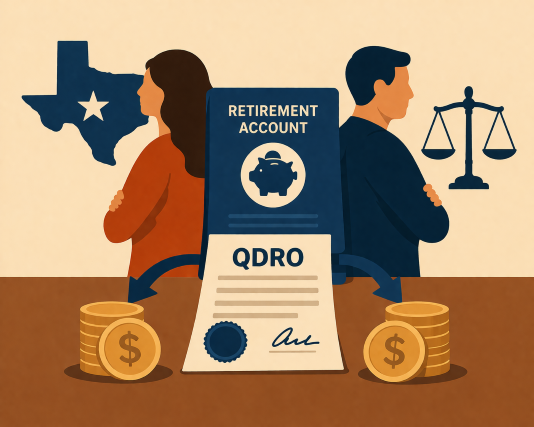

The division of marital property in divorce is a critical financial matter, and retirement accounts are often a key component – especially in cases involving lengthy marriages. When retirement accounts are divided between ex-spouses, the legal tool that’s used is the qualified domestic relations order (QDRO).
Because the process is complex and the outcome is important, working closely with an experienced Round Rock divorce attorney is always in your best interest.
The Division of Marital Property
The State of Texas classifies everything that a couple comes to own during their marriage as a marital asset – regardless of who made the purchase or whose name is attached to the property.
The only exceptions include gifts or inheritances that either spouse received in their name alone during the marriage and the pain and suffering compensation either spouse was awarded in a personal injury case initiated during the marriage.
Separate Assets
The assets that either spouse owned prior to marriage and kept separate throughout their marriage are classified as separate property and remain the private property of the original owner.
For a separate asset to retain its separate nature, however, the owner must keep it financially separate, which can be a tall order in the course of a marriage. In other words, there are a range of situations in which the dividing line between marital and separate assets can be weakened.
The Just and Right Division of Marital Property
In Texas, marital property must be divided in what is called a just and right manner. While this often means equally, there are factors that can support a lopsided division, and considerations include all the following:
The length of the marriage
The age and overall health of each spouse
Each spouse’s separate assets
Each spouse’s earning income and earning power
Any fraud on the marital estate, such as the dissipation of marital assets
Each spouse’s contributions to the marriage, in the form of childcare and homemaking
Retirement Accounts
Retirement accounts are often a primary asset and among the most challenging to divide for a range of reasons. It’s important to note that even if a spouse owned the retirement account before their marriage, that doesn’t necessarily make it an entirely separate asset.
Generally, an account’s value at the time of marriage is identified as separate property, while the amount that the account increased in value during the marriage is identified as marital property that must be divided fairly between the spouses upon divorce.
Considering the Retirement Account
There is a wide range of factors that go into dividing a retirement account in divorce.
For example, the value assigned to an individual retirement account (IRA) is generally calculated in pre-tax dollars, meaning the asset's tax implications are not taken into account. As such, it can be difficult to balance the value of a retirement account with the value of another asset – like your home.
Let’s say the retirement account in question has the same dollar value assigned to your home. This does not mean that swapping your percentage of ownership in one for the other is necessarily a fair trade.
Even if you assume that you’ll receive an equal return on either investment, which is by no means guaranteed, there are other factors to take into consideration. These include the fact that the value of the house already has taxes and fees factored in, while the IRA could lead to serious tax implications in your future.
There is also, however, the matter of your home’s upkeep, which could be quite costly.
The bottom line is that, even before you get down to the business of dividing a retirement account in divorce, you’ve got a complex issue on your hands. Having the skilled legal guidance of a seasoned Round Rock divorce lawyer on your side can make all the difference.
The QDRO
A QDRO is a legal directive that must be signed by the presiding judge. Its purpose is to assist property division in divorce by instructing how one spouse’s retirement plan or deferred compensation will be split.
The QDRO is a distinct order, which means that it’s separate from the divorce decree itself, and it specifically carves out the amount of the retirement account that the other spouse is entitled to.
QDROs are a legal tool for dividing retirement accounts upon divorce without incurring the penalties that go along with early withdrawals. Every QDRO outlines the specifics regarding how the asset will be split, which ensures that the account’s plan administrator will recognize the division and distribute the funds accordingly.
QDROs, however, are not used solely for property division purposes. They can also be implemented for the enforcement of child support and can designate a dependent, such as a child, as an account beneficiary.
The QDRO Division Process
In order to obtain a QDRO, you’ll need to go through a complicated process that requires many steps, each of which is important in relation to the document’s legal validity and enforceability.
Determining the Percentage Awarded
To begin, how the retirement asset will be divided must be determined via careful analysis of multiple relevant factors that include evaluating the plan itself and calculating what part, if any, is separate property.
Retroactively assigning a value to a retirement account as of the time of the marriage can be difficult in and of itself. While multiplying the average annual contribution by the number of years the individual worked prior to marriage is one technique, it can be pretty far off base, especially if the person’s earning power changed considerably over the years.
There are also issues such as cost of living adjustments, early retirement buyouts, and surviving spouse benefits to consider. All of this is not to mention the tax implications of the division.
Ultimately, if you need a QDRO, you’ve got your work cut out for you, and you shouldn’t wait to consult with a knowledgeable Round Rock divorce attorney who has considerable experience successfully handling these challenging legal matters.
Drafting the QDRO
Once the division of the retirement plan is determined, the next step in the process is drafting the QDRO itself. This requires a thorough understanding of the legal intricacies involved, which includes having a working knowledge of the retirement plan’s specific rules and requirements.
Further, the QDRO must use precise legal language that ensures clarity and compliance with all federal regulations and all guidelines set forth by the plan.
In addition to including required personal and financial information, the QDRO must specify how the assets will be divided. This means spelling out the calculation method, which could be a fixed amount, a percentage of the account balance, or a formula based on the number of years married.
Seeking the Plan Administrator’s Preapproval
Before you proceed by submitting your QDRO to the court for approval, it’s a good idea to obtain preapproval from the retirement plan’s administrator. This helps to ensure that the drafted QDRO meets the retirement plan’s specific requirements – as well as all relevant federal laws.
This can spare you further challenges ahead and give you the opportunity to make any required revisions early on, which can speed up final approval considerably.
Obtaining the Court’s Approval
Once you’ve gained the plan administrator’s preapproval, you’ll look to the court for final approval. Once the judge signs off on your QDRO, it will become a legally binding document. This means that it can be enforced by the court, and it ensures that the specifications included will be followed.
Submitting Your QDRO to the Retirement Plan’s Administrator
Finally, you’ll submit your qualified domestic relations order to the retirement plan’s administrator, who will turn to it as a legal directive for compliance. The distribution to the other spouse may be immediate, deferred until the plan participant retires, or based on any other schedule stipulated by the QDRO.
The document will also determine how the distributions will be made, such as in a lump sum, in periodic payments, or by some other means.
Common Errors
Because QDROs are so complex, there is a range of common errors that are closely associated with them.
Submitting an Incomplete or Inaccurate QDRO
One of the most common mistakes made by those submitting QDROs to the court is failing to include accurate and complete information, which can lead to a range of problems.
For starters, the retirement plan administrator may reject the QDRO entirely, but it doesn’t end here. You’re also more likely to experience delays throughout the process and may incur additional expenses. Finally, inaccurate information can ultimately support a misallocation of retirement assets that does not serve your financial best interests.
Failing to Obtain Preapproval
The importance of obtaining preapproval from the retirement plan administrator can’t be stressed enough. There are a significant number of rules and regulations that apply at both the plan and the legal level, and gaining this preapproval helps demonstrate your compliance, which helps to expedite the process.
Skipping this step can not only slow things down but can also lead to problems with the division of retirement benefits that you might not have foreseen.
Waiting to File
It’s important to file your QDRO promptly, which means you should not take an I’ll get to it when I get to it approach. Delays on your part can lead to additional challenges that could translate to a loss of benefits. The sooner you reach out for the trusted legal counsel of a dedicated Round Rock divorce lawyer, the better protected your financial rights will be.
Failing to Consider All the Relevant Retirement Assets
The complexities of divorce ensure that it’s easy to lose track of things along the way, and this can apply directly to retirement assets. You don’t want a retirement account that you have a financial interest in getting lost in the shuffle, which could mean that you’d lose out on the asset entirely.
Because putting your divorce well behind you as you move into your post-divorce future is the goal, it’s important to pay careful attention to the details now, and a skilled divorce attorney can help you with that.
FAQ
The answers to the following frequently asked questions about QDROs may help you with your own.
What is a QDRO?
The term QDRO stands for qualified domestic relations order, and it’s a legal mandate that’s used to divide assets like a spouse’s retirement account or deferred compensation in divorce.
Your QDRO will spell out how the retirement plan administrator must address the division of the retirement assets, and the terms included must be in compliance with the plan itself as well as with all relevant federal laws.
What if my spouse owned the retirement account prior to marriage?
If your spouse owned the retirement account in question prior to the time of your marriage, the value at the time of your marriage is likely to be their separate property, which means you are not entitled to a portion.
However, the amount that it’s grown in value since that time is very likely to be a marital asset that must be split fairly in the course of your divorce.
Do I need an attorney to draft my QDRO?
Divorce is a complicated legal matter, and QDROs are one of the most complicated aspects of divorce. In other words, you owe it to your financial future to have a focused divorce lawyer backing you up from the start.
Turn to an Experienced Round Rock Divorce Lawyer for the Help You Need
Brett Pritchard at The Law Office of Brett H. Pritchard is an accomplished Round Rock divorce attorney who has earned a solid reputation for skillfully navigating the QDRO process and achieving favorable results for his valued clients.
We’re here for you, too, so please don’t put off reaching out and contacting us online or calling us at (254) 781-4222 to schedule a free consultation and learn more about what we can do to help you today.