


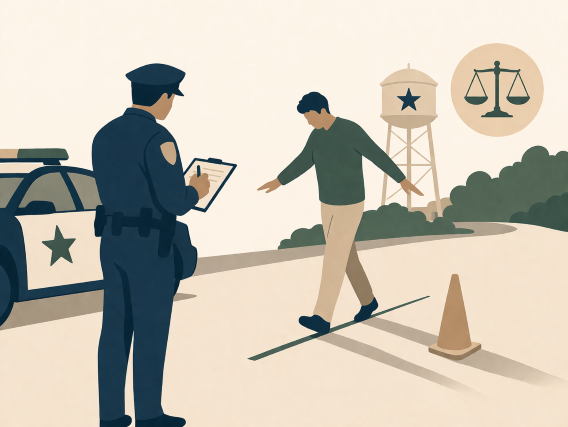

Round Rock drivers face serious consequences when a DWI case rests on field sobriety tests that may not be as scientific as they appear. Police officers in Williamson County rely heavily on roadside exercises to decide whether to arrest a driver and request a breath or blood test.
A Round Rock DWI defense lawyer will often focus on those same tests as a starting point for challenging the State’s version of events and protecting your record.
A skilled DWI defense attorney with The Law Office of Brett H. Pritchard will examine how field sobriety tests were given in your case. We will closely examine how the officer scored them and whether the evidence actually proves intoxication under Texas law. If we find any irregularities, we will use them to convince the court to throw out your case.
Texas DWI Law and Why Field Sobriety Tests Are Challenging
Texas treats DWI as a serious offense, even for a first arrest. State law makes it illegal to drive while intoxicated, and note that a BAC of 0.08 is the usual legal limit. However, impairment at any level can still support a charge.
Prosecutors in Round Rock often present field sobriety tests as proof that a driver lost normal use of mental or physical faculties. A Round Rock DWI defense lawyer will approach those tests as only one piece of a larger picture that includes video, officer reports, and your personal history.
Courts admit field sobriety tests into evidence because they are based on standardized federal training materials that describe how officers should perform and score each exercise.
A DWI defense attorney will use those same manuals to show where an officer departed from the required instructions, took shortcuts, or misread normal behavior as signs of intoxication. Jurors in Williamson County often respond when a defense presentation walks through each step and shows how small errors can create a misleading impression.
Standardized Field Sobriety Tests Used in Texas
Most Round Rock DWI stops rely on the standardized field sobriety test (SFST) battery endorsed by the National Highway Traffic Safety Administration (NHTSA). That battery includes three main exercises: the Horizontal Gaze Nystagmus (HGN) eye test, the One-Leg Stand, and the Walk-and-Turn.
A DWI defense attorney will know that these tests were validated only under controlled conditions and with specific instructions, not on a dark roadside with flashing lights and heavy traffic.
Commonly used tests include:
HGN (involuntary eye movement while following a stimulus)
One-Leg Stand (standing on one leg while counting out loud)
Walk-and-Turn (nine heel-to-toe steps down a line, then turn and return)
Research behind the SFST battery assumes that the subject has no balance issues, no significant medical problems, and a level, dry surface under adequate lighting.
A Round Rock DWI defense lawyer will often point out that real-world traffic stops in Williamson County rarely match those ideal conditions. Gravel on the shoulder, sloped pavement, or high winds can all affect how a sober driver performs.
Officers receive training to look for specific “clues” such as stepping off the line, raising arms for balance, starting early, or missing heel-to-toe contact.
A committed defense attorney will question whether the officer truly saw each clue, whether the dash or body camera video supports those notes, and whether the officer added extra scoring points that do not appear in NHTSA materials.
That careful comparison can expose overstatements or honest mistakes that weaken the State’s claim of reliable testing.
Limits of the Horizontal Gaze Nystagmus Test
HGN receives special attention in many Texas DWI trials because officers often claim it is the most scientific test. Nystagmus refers to a jerking eye movement that can appear when someone looks to the side, and alcohol can increase the effect.
When a defense lawyer reviews an HGN test, the focus will extend beyond the officer’s conclusion and move into how the officer positioned the stimulus, how far it moved, and how long each pass lasted.
Medical conditions, fatigue, certain prescription drugs, inner ear problems, and even natural eye differences can produce nystagmus that looks similar to alcohol-related signs. A knowledgeable defense attorney will ask whether the officer asked about those conditions, whether the driver wore contact lenses, and whether the driver had a history of eye surgeries or injuries. If the officer skipped those questions, a judge or jury may decide that the HGN result carries little weight.
HGN also demands precise timing and distance. NHTSA materials describe how many seconds the officer should spend moving the stimulus and how far from the face it should be held.
Your Round Rock DWI defense lawyer will often slow the dash or body camera video down and compare each movement to national standards. Shortcuts in timing, rough movements, or sudden changes in direction can all cause the eyes to jerk even when a driver is sober.
Problems With Walk-and-Turn and One-Leg Stand
Walk-and-Turn and One-Leg Stand are divided-attention tests. Drivers must listen to instructions, remember several steps, and perform a physical task simultaneously.
A capable DWI defense attorney will ask the officer to describe exactly what was said, where the instructions were given, and whether loud traffic or weather conditions made it hard to hear. Confusion about instructions can easily look like intoxication on video, even when the real problem is poor communication.
Roadside surfaces create another common problem. Highway shoulders near Round Rock often slope away from the roadway for drainage, and many neighborhood streets have uneven joints or patched areas.
A Round Rock DWI defense lawyer will highlight those details and may use photographs or video still images to show the jury the actual walking surface. Jurors often understand that heel-to-toe walking on a narrow, sloped edge is difficult even when someone has not consumed any alcohol.
Physical limits make these tests even less reliable. A driver with knee pain, back problems, extra weight, or a simple lack of coordination can struggle with balance tasks even when sober.
A careful defense attorney will ask whether the officer inquired about age, injuries, or need for supportive footwear. When the officer gives the same test to a young athlete and a middle-aged driver with a history of surgeries, the fairness of the scoring becomes a central question for the court.
Environmental and Procedural Factors That Undermine Results
Field sobriety tests rarely occur in a calm, quiet setting. Patrol car lights flash in the driver’s eyes, traffic rushes by, and the driver may already feel intense stress from the stop.
A thoughtful defense lawyer will emphasize how nerves and fear can cause shaking, uneven speech, and trouble following multi-step directions, all of which officers sometimes treat as signs of intoxication.
Real-world traffic stops also include many small environmental factors that testing manuals do not fully address. Common issues include:
Poor lighting or headlight glare that affects depth perception.
Loose gravel, wet pavement, or high winds that affect balance.
Passing traffic noise that makes instructions difficult to hear.
A dedicated DWI defense attorney will question officers about why they did not move to a flatter or better-lit spot, why they did not repeat unclear instructions, or why they pressed forward even when the driver complained of physical discomfort.
That methodical questioning can show that the officer focused more on collecting “evidence” than on conducting a fair test.
Medical Conditions and Individual Differences
Each driver brings a unique medical and personal history to a traffic stop. Some people live with chronic vertigo, inner ear disorders, diabetes, neurological conditions, or anxiety that affect balance, eye movement, and concentration.
A focused Round Rock DWI defense lawyer will review medical records, pharmacy records, and witness statements to explain why a particular client struggled with certain exercises.
Prescription medications often appear in DWI cases. Some have side effects that include drowsiness, blurred vision, or muscle weakness.
Your DWI defense attorney will ask detailed questions about any medications and will often consult medical literature or, when appropriate, a medical professional to show that side effects, rather than intoxication, explain the officer’s observations.
When the jury hears that a prescribed drug can cause staggered walking or slurred speech even without alcohol, the strength of the State’s case may change.
Age and weight also influence test performance. Older drivers and those with higher body weight may not move as quickly or smoothly as young adults used in validation studies.
A Round Rock DWI defense lawyer will ask jurors to compare the driver on video to the healthy volunteers standing on flat surfaces in the federal training materials. That comparison can help jurors question whether a few stumbles truly show intoxication or simply reflect ordinary human limits.
Police Training, Instructions, and Documentation
Field sobriety testing depends heavily on how well the officer remembers and uses the training. NHTSA’s most recent standardized field sobriety testing curriculum includes detailed steps, time counts, and scoring rules that officers are supposed to follow.
A skilled DWI defense attorney will request training records, continuing education certificates, and copies of the exact manuals used by the arresting officer. Gaps in training or outdated materials can become powerful impeachment tools during cross-examination.
Written and digital records provide another field for challenges. A determined defense attorney will compare the arrest report, video, in-car audio, and any later statements line by line. Differences about the number of clues observed, the length of the tests, or the driver’s comments about fatigue or injuries can raise credibility questions.
Williamson County jurors tend to take such differences seriously because they point to either sloppy recordkeeping or a memory shaped by the desire to support an arrest decision.
Challenging Field Sobriety Tests in Round Rock Courts
Round Rock DWI cases move through Williamson County criminal courts, where prosecutors often present field sobriety evidence early and often. A Round Rock DWI defense lawyer will respond by filing motions that challenge the traffic stop, the decision to request field tests, and the officer's conduct during each test.
When a judge finds serious flaws, part or all of the test evidence may be excluded from trial.
Even when a judge allows the tests, defense counsel can still weaken their impact before a jury. A strategic DWI defense attorney will often use enlarged photographs, blowups of the NHTSA instruction pages, and slow-motion video playback to walk jurors through what really happened on the roadside.
Careful questioning can help jurors see how stress, weather, physical limits, and officer shortcuts all combine to create test results that do not reliably prove intoxication under Texas law.
Prosecutors sometimes claim that field sobriety tests are only one part of the case and that any errors are minor. Your Round Rock DWI defense lawyer will respond by reminding jurors that Texas law requires proof beyond a reasonable doubt.
When core evidence rests on tests that only work under ideal conditions described in federal training materials, and when the State cannot show those conditions existed on the roadside, doubt becomes a reasonable conclusion.
Protecting Your License and Future After a DWI Arrest
Field sobriety tests affect more than the criminal case. Texas drivers also face administrative license suspension proceedings that look closely at whether the officer had reasonable suspicion for the stop and probable cause for arrest.
A capable DWI defense attorney will request the administrative hearing, subpoena the officer, and use cross-examination about field sobriety testing to challenge probable cause as early as possible. Strong performance at the hearing can help both the license case and the later criminal trial.
Even when chemical test results show a BAC at or above 0.08, problems with field sobriety tests still matter. Courts in Texas recognize that officers use these exercises to decide whether to request a breath or blood sample in the first place.
Your lawyer will argue that unreliable tests can taint later decisions, especially when video shows a driver who appears steady and polite despite the officer’s description of severe impairment.
Let a Seasoned Round Rock DWI Defense Attorney Work for You
Round Rock drivers facing DWI charges based on field sobriety tests deserve a careful legal review of every step taken on the roadside and in the courtroom. The criminal defense team at The Law Office of Brett H. Pritchard conducts a detailed evaluation of the evidence to identify whether and how those tests can be challenged under Texas law.
Our attorneys explain your legal options and take action to protect your license, freedom, and future. Call 254-781-4222 or contact us online to discuss your case.