


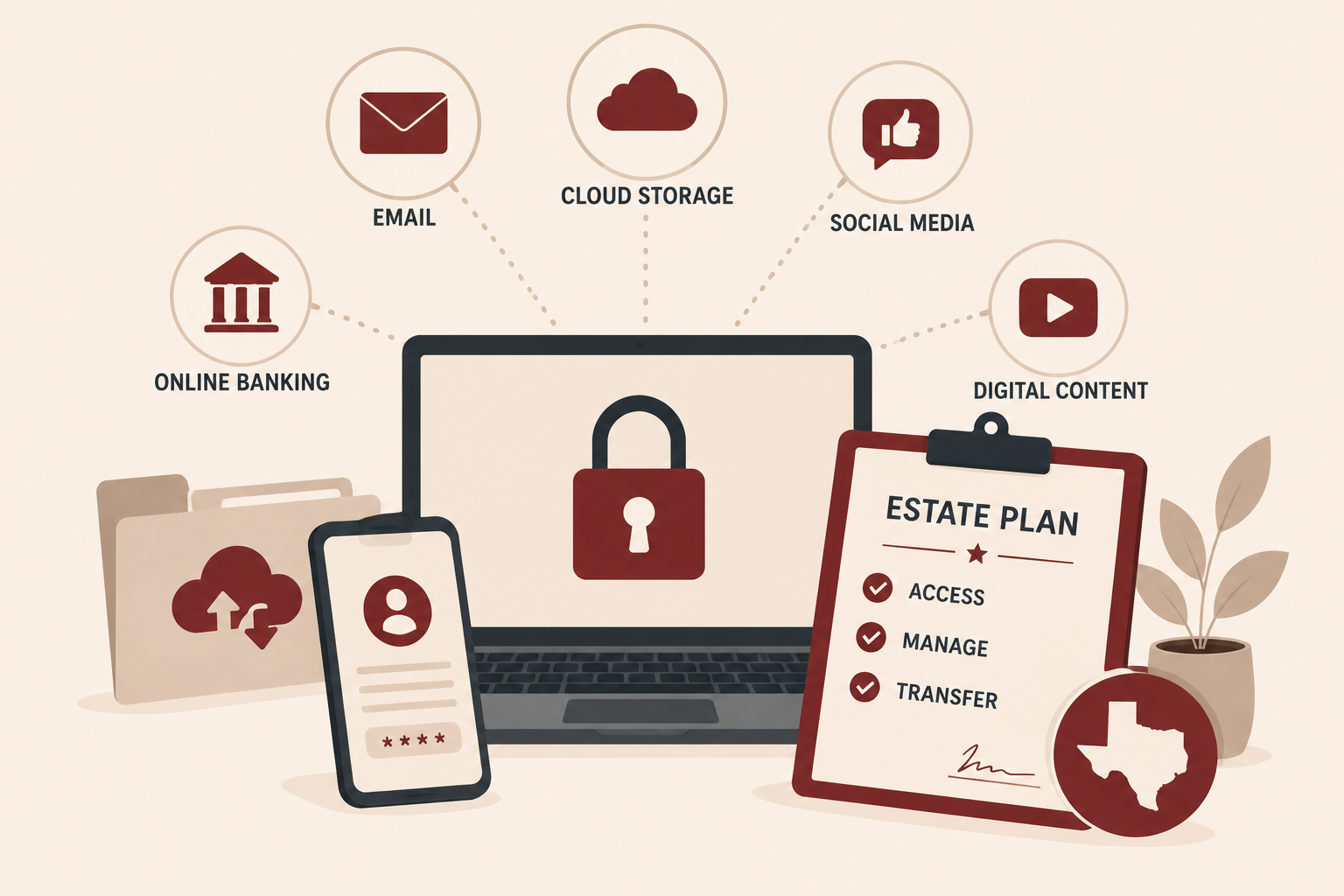

Most people spend considerable time planning for the distribution of their physical assets and financial accounts. Far fewer think about their digital lives, and the consequences of that oversight can be significant for the families left behind.
The bottom line: Digital assets are a real and growing part of every estate. Without specific instructions in your estate plan, your family may lose access to valuable accounts, sentimental files, and even cryptocurrency permanently. Texas law provides a framework for addressing these assets, but it only works if the right planning documents are in place.
Key Takeaways
Digital assets include online payment accounts, cryptocurrency, social media, email, income-generating platforms, cloud photos, and intellectual property.
Standard will templates typically do not adequately address digital assets, leaving significant gaps in an estate plan.
Cryptocurrency is particularly vulnerable. Without the correct access credentials, accounts can be permanently locked.
Texas adopted the Revised Uniform Fiduciary Access to Digital Assets Act (RUFADAA) in 2015, giving estate executors legal authority to manage digital assets.
Your estate planning documents must be consistent with the terms of service of each individual platform.
Passwords and login credentials should never be included in a will, which becomes public record during probate.
A Killeen estate planning attorney can draft the specific language needed to protect your digital estate.
What Is a Digital Asset?
The term "digital asset" is broader than most people realize. It covers practically every online account you have, with the exception of bank and investment accounts, which are controlled by beneficiary designations.
Digital assets include:
Online payment accounts such as PayPal and Venmo, and any balances held in them
Cryptocurrency accounts and your holdings
Online accounts that generate revenue, such as YouTube and TikTok channels
Photos stored in the cloud that have sentimental value
Email accounts and their contents
Online subscriptions
Professional assets such as domain names and other intellectual property
Whether these assets carry monetary value, sentimental value, or both, they deserve a place in your estate plan.
Why Cryptocurrency Requires Special Attention
Cryptocurrency is the most unforgiving category of digital asset when it comes to estate planning. There is no bank, no customer service department, and no account recovery process. If your family does not have the right information, your crypto holdings could be permanently lost.
Too many failed login attempts will lock the account in a way that cannot be reversed. Without the correct private key and seed phrase, the account remains inaccessible, and the assets inside it are lost.
Your estate plan must ensure your family has access to the following information:
Where the seed phrase and private keys are stored, with explicit instructions for finding them
Whether a hardware wallet is involved, and if so, its location, PIN, and any additional security layers
Which exchange accounts you hold, along with executor authorization to access them
Who will receive the crypto, and whether that person has the technical knowledge to manage it safely
Actual login credentials and private keys should never be included in your will. Wills become public record during probate, which means anyone could gain access to that information. Store credentials separately in a secure location and ensure your executor knows where to find them.
Why Standard Wills Fall Short
A will template downloaded online or built around generic language is unlikely to address digital assets adequately. General language, such as "all personal property," does not clearly encompass digital accounts, and this ambiguity can leave your family with no clear path to access or control these assets.
Standard wills also do not accomplish the following important purposes:
Identify the specific accounts you hold
Provide instructions for how to access those accounts
Account for platform terms of service, which sit above your estate planning documents in the legal hierarchy
When your estate planning documents conflict with a platform's terms of service, the platform's rules prevail. Without clear, compliant instructions, your executor may be legally unable to access the account at all.
The consequences are not just sentimental. Families lose real money every year because of inaccessible cryptocurrency wallets, unmanaged income-generating accounts, and online balances that go unclaimed. Acting now protects your family from that outcome.
Texas Law and Digital Assets: What You Need to Know
In 2015, Texas adopted the Revised Uniform Fiduciary Access to Digital Assets Act (RUFADAA). This law gives the executor of your estate the legal authority to access and manage your digital assets as part of their estate duties.
However, RUFADAA does not operate automatically or independently. It requires:
Core estate planning documents that name an executor
Estate planning language that is consistent with each platform's terms of service
Specific instructions regarding digital assets, because generic estate language will not be sufficient
Without an executor named in your documents, no one has the legal authority to administer your digital assets. Without specific language, your executor may still be blocked from accessing individual accounts.
How to Take Inventory of Your Digital Assets
Before you can plan for your digital assets, you need to know what you have. Consider the full scope of your online presence, including subscriptions, which your estate may continue to be billed for after your death if they are not canceled.
Best practices for managing your digital asset inventory:
Do not include passwords or login credentials in your will, which becomes public record during probate.
Consider storing this information in a separate encrypted spreadsheet, a digital vault, or a handwritten document kept in a fireproof physical safe.
Review and update your inventory at least once a year.
Update credentials immediately when you change the password on a major account.
How to Address Digital Assets in Your Will
Generic language is not enough. Your will must specifically address your digital assets with clear, granular instructions.
Appoint the Right Executor
You can designate the same executor who manages your physical estate to also oversee your digital assets, or you can appoint a separate executor with stronger technical expertise. Either approach can work, but the choice should reflect who is best equipped to manage each type of account.
Provide Specific Instructions by Asset Type
Your will should include separate instructions for each major category of digital asset:
Financial accounts: Transferred to a named beneficiary or liquidated and added to the estate
Cryptocurrency: Transferred to a beneficiary with clear instructions for accessing the wallet
Social media: Memorialized, deleted, or transferred per your specific instructions
Income-generating assets: Continued, sold, or wound down, with clear authority over who makes that call
Sentimental assets: Downloaded and distributed among family members per your wishes
Intellectual property: Who inherits the rights and how they may be used
Drafting this language correctly requires accounting for both RUFADAA and the terms of service of each individual platform. A seasoned Killeen estate planning attorney is the most reliable resource for getting this right.
Consider Your Entire Estate Plan
Digital assets must be integrated into your broader estate plan, not treated as an afterthought. A complete approach includes the following provisions in your estate planning documents:
Your will should name an executor and provide binding instructions for the distribution of digital assets.
A durable power of attorney can allow a designated agent to manage your digital assets even while you are still alive if it includes specific language addressing digital assets, not just generic authority language.
Provide direct instructions to individual platforms, identifying who can manage or access an inactive account.
When you conduct a periodic review of your estate plan, make sure digital assets are a part of that review. Even if nothing else has changed, growth in your digital footprint alone can require updates.
Why You Need to Act Now
Digital assets do not wait for a convenient time to become a problem. A sudden accident, an unexpected diagnosis, or an urgent change in circumstances can eliminate your opportunity to plan almost overnight.
Unlike a forgotten savings account that a family can track down through a bank, an unplanned digital estate can disappear permanently. A locked cryptocurrency wallet, a cloud photo library with no authorized access, and an online business with no one holding legal authority to run it are all real risks — and they are all preventable with the right planning in place today. The longer you wait, the more complicated the planning becomes.
Ready to Protect Your Digital Estate in Killeen, TX?
The estate planning attorneys at the Law Office of Brett H. Pritchard in Killeen, Texas, can help you build a comprehensive plan that accounts for all of your assets, including those that are digital. Do not leave your family to figure it out on their own.
Call (254) 781-4222 or contact us online to schedule a FREE consultation today.
Frequently Asked Questions
What counts as a digital asset for estate planning purposes?
Digital assets include online payment accounts such as PayPal and Venmo, cryptocurrency holdings, revenue-generating online accounts such as YouTube channels, cloud-stored photos, email accounts, online subscriptions, domain names, and other intellectual property. Bank and investment accounts are generally excluded because they are governed by beneficiary designations.
What happens to my cryptocurrency if I die without an estate plan?
Without the correct private key and seed phrase, your cryptocurrency account may be permanently locked. Too many failed access attempts will lock the account in a way that cannot be reversed. There is no customer service department or account recovery process for most crypto accounts. Your holdings can be lost permanently.
Can I just include my digital accounts in my regular will?
A standard will with generic language such as "all personal property" does not clearly cover digital assets. Your will must include specific language for each type of digital account. It must also be consistent with the terms of service of each platform, which take precedence over your estate planning documents.
Should I include my passwords in my will?
No. Your will becomes public record during probate, which means anyone could access that information. Store login credentials and private keys in a separate secure location, such as an encrypted digital vault or a fireproof physical safe, and make sure your executor knows where to find them.
What is RUFADAA and how does it affect my digital estate in Texas?
RUFADAA is the Revised Uniform Fiduciary Access to Digital Assets Act, adopted by Texas in 2015. It gives the executor of your estate legal authority to access and manage your digital assets. However, it only works if you have the proper estate planning documents in place, including a named executor and language specific to digital assets.
Can a power of attorney cover digital assets?
Yes, but only if the document includes specific language addressing digital assets. Generic power of attorney language does not grant decision-making authority over digital accounts. A knowledgeable Killeen estate planning attorney can ensure the right language is included.
How do I get started with digital asset estate planning in Killeen, TX?
Contact the Law Office of Brett H. Pritchard to schedule a FREE consultation. Our estate planning attorneys can help you build a comprehensive plan that accounts for all of your assets, including digital ones. Call (254) 781-4222 or contact us online today.