


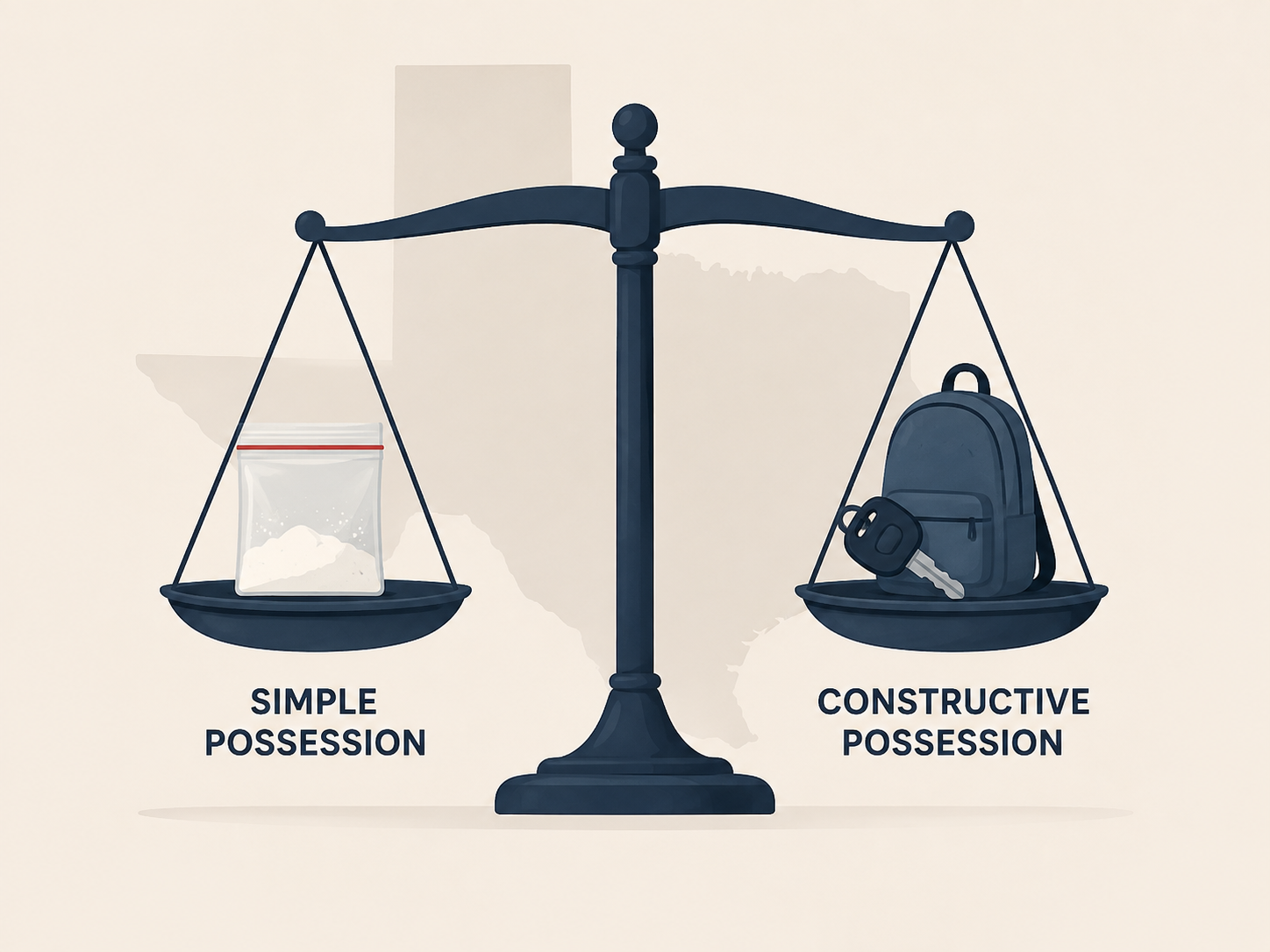

Being charged with drug possession in Texas does not always mean the drugs were found on your person. Understanding the difference between simple possession and constructive possession and how the state builds these cases can be critical to defending yourself effectively.
The bottom line: Simple possession means the drug was physically on you. Constructive possession means the state can connect you to a drug that was nearby but not directly on your person. Both carry serious penalties, and both require an experienced defense strategy.
Key Takeaways
Simple possession means a drug was physically on you or under your direct control.
Constructive possession means the drug was in your vicinity or within your reach, not necessarily on you.
To prove constructive possession, the prosecution must establish knowledge, control, and presence.
Texas drug penalties are based on the penalty group classification and the amount of the drug involved.
Whether the charge involves simple or constructive possession can affect the prosecution's leverage and the outcome.
An experienced Killeen drug defense attorney can evaluate the specific facts of your case and build the strongest possible defense.
Texas Drug Penalty Groups
Drug possession charges in Texas hinge primarily on two factors: the type of drug involved and the amount. Prior convictions can also significantly affect the outcome. Texas classifies controlled substances into penalty groups ranked from most to least severe.
Penalty Group 1
Penalty Group 1 includes the most dangerous drugs with the fewest clinical applications and the highest association with dependency. Examples include cocaine, heroin, meth, ketamine, and psychedelic mushrooms.
Key penalties:
Less than 1 gram: state jail felony; 6 months to 2 years in state jail; fines up to $10,000
4 to 200 grams: second-degree felony; 2 to 20 years in prison; fines up to $10,000
Possession of paraphernalia associated with meth use, such as hollowed-out pens, bottle caps, or needles, can add an additional $500 fine.
Penalty Group 1-A
Penalty Group 1-A is reserved exclusively for LSD, which is charged by units rather than weight.
Units | Charge Level |
Fewer than 20 units | State jail felony |
20 to 80 units | Third-degree felony; up to $10,000 in fines; 2 to 10 years in prison |
80 to 4,000 units | Second-degree felony |
4,000 to 8,000 units | First-degree felony |
Penalty Group 2
Penalty Group 2 includes ecstasy, PCP, hash, and other cannabinoids, including marijuana.
Less than 1 gram: State jail felony
1 to 4 grams: Third-degree felony
Penalty Group 3
Penalty Group 3 includes anabolic steroids, Valium, Xanax, Ritalin, and opioids not listed in Group 1.
Less than 28 grams: Class A misdemeanor; up to 1 year in jail; fines up to $4,000
Penalty Group 4
Penalty Group 4 includes compounds containing smaller amounts of certain narcotics with abuse potential, such as codeine. Penalties mirror those in Penalty Group 3.
Marijuana Possession in Texas
Although marijuana falls under Penalty Group 2, it occupies something of its own category. Texas has not legalized recreational marijuana, but the state has softened its approach to low-level offenses somewhat. Officers in Killeen generally do not make arrests for very low-level marijuana offenses when no other illegal activity is involved, though this remains at the discretion of the arresting officer.
Marijuana possession penalties in Texas:
Amount | Charge | Penalties |
Less than 2 ounces | Class B misdemeanor | Up to $2,000 fine; up to 6 months in jail |
2 to 4 ounces | Class A misdemeanor | Up to $4,000 fine; up to 1 year in jail |
4 ounces to 5 pounds | State jail felony | Up to $10,000 fine; 6 months to 2 years in state jail |
5 to 50 pounds | Third-degree felony | Up to $10,000 fine; 2 to 10 years in prison |
50 to 2,000 pounds | Second-degree felony | Up to $10,000 fine; 2 to 20 years in prison |
Over 2,000 pounds | First-degree felony | Up to $10,000 fine; 5 to 99 years (or life) in prison |
What Is Simple Possession?
Simple possession, also called actual possession, means the drug was physically on your person. This includes being in your pocket, bag, shoe, or clothing, or even having swallowed the drug. Texas defines actual possession broadly. If the drug is in your care, custody, or under your control or management, the requirements for possession are met.
While not knowing an illegal drug was on you can be addressed as a defense for drug charges, police only need to establish that the drug was on your person to charge you.
What Is Constructive Possession?
Constructive possession means you can be charged with drug possession even when the drug was not physically on you. At its most basic, constructive possession applies when drugs were in your general vicinity, within your reach, or within your control.
For example, if you were sitting with friends around a coffee table with drugs on it, you could face possession charges even if you never touched, used, or owned the drugs because everyone present had equal control over the substance on the table.
The Three Elements the Prosecution Must Prove
To convict you of constructive possession, the prosecution must establish three elements:
1. Knowledge
You must have known the drugs were present and that they were illegal. If your roommate secretly stores illegally obtained drugs in a shared medicine cabinet without your knowledge, proving your awareness is difficult. Drugs spread openly on a coffee table in front of you are much harder to distance yourself from.
2. Control
You must have had the ability to exercise control over the drugs. Access to the location where drugs are found, such as a shared bathroom or common area, can suggest control. Drugs locked in your roommate's private bedroom without your knowledge present a much stronger argument against control.
3. Presence
Presence refers to your physical location in relation to the drugs. Being in the same room as drugs that are in plain view establishes presence. Drugs hidden in a locked room you have no access to are much less likely to establish presence in relation to you.
Evidence Used to Prove Constructive Possession
Constructive possession cases are built on circumstantial evidence. The prosecution may use the following common types of evidence:
You owned or occupied the premises where the drugs were found.
You had unrestricted access to the location, such as possessing a key.
You were in close proximity to drugs that were in plain view.
You made an attempt to hide or dispose of the drugs.
Drug paraphernalia was present at the location.
Your fingerprints were found on drug containers or paraphernalia.
You made incriminating statements connecting you to the drugs.
Real-World Constructive Possession Scenarios
In a Friend's Car
If you were a passenger in a vehicle that was pulled over and the driver was found to have drugs in the console or glove box, you could potentially face a possession charge, even if the drugs were not yours. The more evidence there is that you knew about the drugs, such as any attempt to conceal them, the greater the likelihood of a charge.
In a Friend's Apartment
If you were staying with a friend and drugs were found in the kitchen during your stay, constructive possession could apply to you. Fingerprints on the cabinet door, the shelf, or the drug container could give the state a strong case. Even without fingerprints, evidence that you had access to the area and some indication that you knew about the drugs could be enough to proceed.
In a Public Place
If you were in a group in a public space and someone tossed a bag of drugs under the bench where you were all sitting, constructive possession charges could apply to the entire group. Any behavior that draws additional attention to you individually could increase the legal focus on your involvement.
Simple vs. Constructive Possession: How It Affects Your Case
Penalties for drug charges are generally determined by the penalty group and the amount of the drug involved. However, whether the charge involves simple or constructive possession can influence the outcome.
The state is generally in a stronger position to prove its case when the defendant was in actual physical possession of the drug. When the charge relies on constructive possession, the prosecution often faces greater evidentiary challenges and may be more willing to negotiate a plea deal.
Facing Drug Possession Charges in Killeen, TX? We Can Help.
Any drug conviction carries serious consequences for your future. Brett Pritchard at the Law Office of Brett H. Pritchard is a dedicated Killeen drug defense attorney who understands the gravity of your situation and will not falter in defending your rights and pursuing the best possible resolution for your case.
Call (254) 781-4222 or contact us online to schedule a FREE consultation today.
Frequently Asked Questions
What is the difference between simple and constructive drug possession in Texas?
Simple possession means the drug was physically on your person or directly under your control. Constructive possession means the drug was in your vicinity or within your reach — not on you directly — but the state can still connect you to it legally.
What must the prosecution prove for a constructive possession charge?
To convict someone of constructive possession, the prosecution must prove three elements: that you had knowledge the drugs were present and illegal, that you had the ability to control the drugs, and that you were present in proximity to them.
Can I be charged with drug possession if the drugs were in someone else's car or home?
Yes. If you had knowledge of the drugs, were in proximity to them, and had any ability to exercise control over them, constructive possession charges can apply, even if the drugs belonged to someone else.
How does Texas classify drugs for possession charges?
Texas classifies controlled substances into penalty groups, from Penalty Group 1 (the most dangerous, such as cocaine, heroin, and meth) through Penalty Group 4. LSD has its own classification under Penalty Group 1-A and is charged by units rather than weight.
Does constructive possession carry the same penalties as simple possession?
The penalties are based on the type and amount of the drug involved, regardless of whether the charge is simple or constructive. However, constructive possession cases are generally harder for the state to prove, which can affect the prosecution's willingness to negotiate a plea deal.
What should I do if I am facing drug possession charges in Killeen, TX?
Contact an experienced drug defense attorney as soon as possible. Brett Pritchard at the Law Office of Brett H. Pritchard in Killeen, Texas is ready to evaluate your case and build the strongest possible defense. Call (254) 781-4222 or contact us online to schedule a FREE consultation today.